 weavify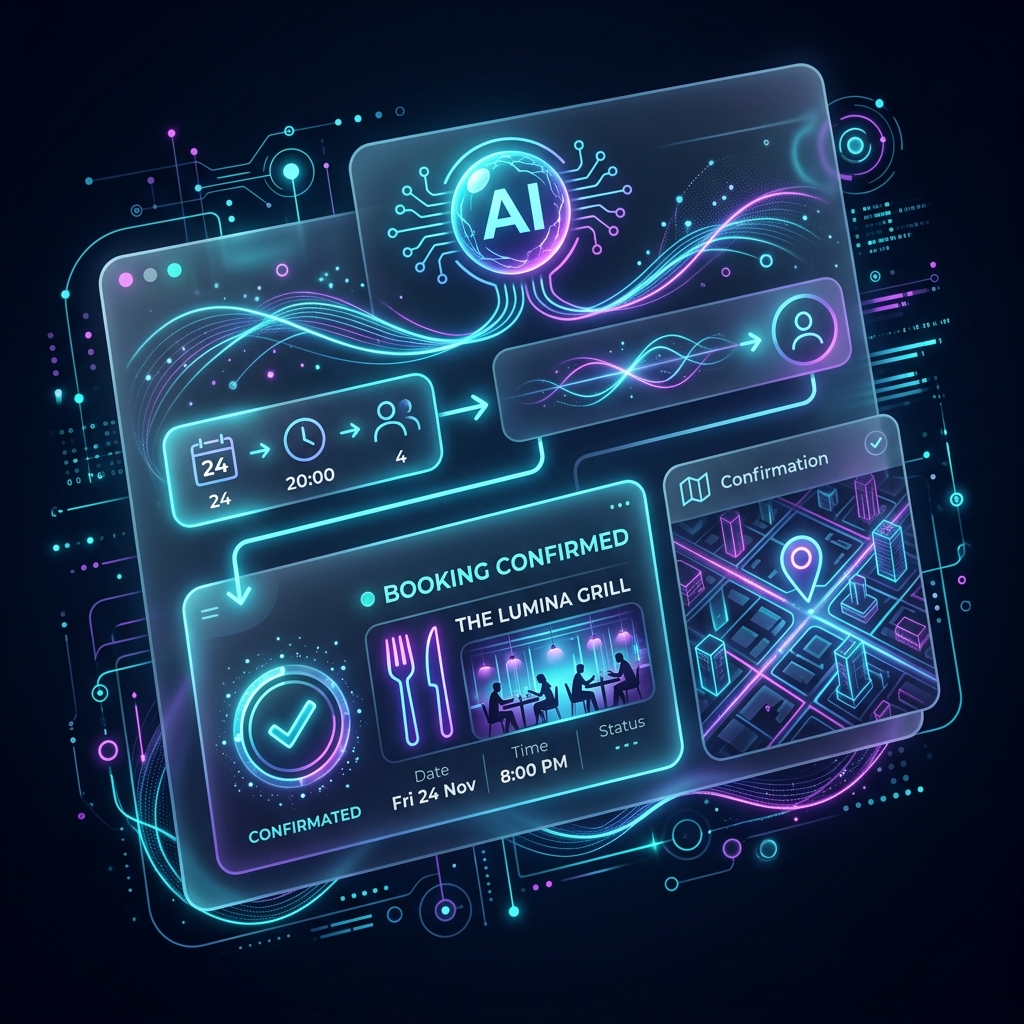
You ask ChatGPT for a rooftop bar in Sukhumvit with great sushi, seats for four, tonight at eight. It gives you three perfect options in seconds. Then you say "book it", and the whole thing falls apart.
The Last Mile Problem Nobody Talks About
AI assistants have gotten remarkably good at the discovery side of dining. They parse your preferences, cross-reference reviews, factor in location and cuisine, and produce recommendations that genuinely make sense. The technology behind this (natural language understanding, retrieval-augmented generation, real-time web search) has matured fast.
But recommendations are only half the job. The moment a customer moves from "that sounds perfect" to "make it happen," the AI hits a wall. It cannot check real-time availability. It cannot submit a reservation. It cannot process a deposit. Instead, it hands you a link, a phone number, or a polite apology.
This is what the industry calls the "last mile" problem. And it is costing hospitality businesses more revenue than most of them realize.
The 60-70% Revenue Leak
Consider the math. A user who tells an AI "book it" has roughly 95% purchase intent. They have already decided. They want the transaction to happen. But the moment they are redirected away from the conversation (to a website, a booking widget, a phone call) friction takes over.
Standard web booking forms already suffer around 50% abandonment on their own. Layer on the context-switching penalty of leaving an AI conversation (which research from Nielsen Norman Group estimates at 10-30% additional drop-off), and the effective conversion from "AI recommends plus user says book it" to a completed reservation is only 25-35%.
That means 60-70% of high-intent customers leak out of the funnel because of infrastructure, not because of lack of demand.
"A user who tells an AI 'book it' has 95% purchase intent. Redirect-based flows convert only 25-35% of those. That is a revenue leak caused by infrastructure, not demand."
How the Major Platforms Handle Bookings Today
Each AI platform is trying to solve this differently, and none of them have cracked it for independent restaurants.
ChatGPT launched Operator in 2025, a browser-controlling agent that literally navigates web forms on your behalf. It is clever, and it proves the demand is real. But it is also slow (30-60 seconds per booking attempt), brittle (breaks whenever a site updates its layout), and limited to Pro subscribers. It is a brute-force workaround, not a real solution.
Google Gemini can surface a "Reserve a table" button through its Reserve with Google partnerships, but this is not yet conversational. You still leave Gemini's interface and land on a third-party booking page. The experience is transactional, not agentic.
Claude takes a different approach entirely. Anthropic built the Model Context Protocol (MCP), an open standard that lets AI connect directly to external services through structured APIs. Rather than scraping websites, Claude can call a booking endpoint the same way a mobile app calls a server. The catch? The restaurant needs to expose that endpoint first.
Why Web Forms Are the Real Bottleneck
The deeper issue is not any single AI platform. It is the fact that websites were designed for humans, and booking forms are the most human-dependent part of the entire experience.
Think about what a typical restaurant booking form requires: date pickers that rely on mouse clicks, time selectors built as JavaScript widgets, CAPTCHA challenges specifically designed to block non-humans, multi-step wizards that demand visual navigation, and session-based authentication that expires unpredictably.
An AI agent has no eyes, no cursor, no ability to interpret a green highlight on a calendar as "available." Even the best browser-automation agents achieve roughly 85% accuracy per individual action. That sounds high until you run the compound math: a ten-step booking flow at 85% per step succeeds only about 20% of the time.
Forms are not just inconvenient for AI. They are architecturally hostile to it.
The Read/Write Divide
Here is the simplest way to understand the gap. Current AI is almost entirely read-only. It can read the web, summarize reviews, parse menus, and compare options brilliantly. What it mostly cannot do is write, make a reservation, process a payment, submit an order, or update a calendar.
The write layer requires things that most restaurants simply do not have: structured API endpoints that accept machine-readable requests, secure authentication for agents acting on behalf of users, confirmation loops where the AI verifies details before committing, and structured error handling that tells the AI "that slot is full, but 7:30 and 8:30 are available."
Travel figured this out decades ago with Global Distribution Systems. E-commerce figured it out with Stripe and Shopify APIs. Hospitality dining is still waiting for its equivalent.
The Booking Platform Problem
You might assume the big reservation platforms would solve this. They have not.
OpenTable, despite seating over 1.5 billion diners globally, keeps its API tightly controlled. There is no open public booking API for third-party developers or AI agents. Resy, now owned by American Express, is similarly locked down. SevenRooms has the most open API of the three, with endpoints for reservations, guest profiles, and availability, but access requires a partnership agreement.
In Bangkok specifically, the situation is even more fragmented. Eatigo, QueQ, Hungry Hub, none expose structured booking endpoints. The vast majority of businesses handle reservations through LINE messages, phone calls, or Instagram DMs. There is no structured data, no API, nothing an AI agent can reliably interact with.
Explore the Bangkok business directory and you will see the diversity of the scene. Getting all of these businesses bookable by AI requires a fundamentally different approach than expecting each one to build its own API.
What the Solution Actually Looks Like
The answer is not asking restaurants to become software companies. It is building a middleware layer, a bridge between AI agents and business inventory that translates conversational intent into structured transactions.
Imagine the flow working like this: a customer asks an AI assistant for dinner recommendations. The AI queries a structured API and returns three options with real-time availability. The customer picks one. The AI submits a booking request through the same API, receives a confirmation, and relays it back, all within the same conversation. No redirects, no forms, no context switching.
This is not a hypothetical. Booking.com already does this for hotels with its AI Trip Planner. The difference is that Booking.com owns the entire stack. For independent restaurants, bars, and nightlife businesses, someone needs to aggregate and standardize the inventory so AI agents can access it through a single, consistent interface.
That is exactly what Weavify is building: a read-write bridge that turns fragmented business data into structured, AI-accessible endpoints. Businesses manage their inventory through a simple dashboard. AI agents book through a standardized API. The business never needs to write a line of code.
The Window Is Open Now
AI-mediated bookings are not a distant future. OpenTable is already integrated with ChatGPT for restaurant search. Google is expanding Reserve with Google. Agentic traffic (visits originating from AI agents) is converting at 15-30%, which is 5-10 times higher than traditional e-commerce.
The businesses that become bookable by AI early will capture this demand. The ones that remain invisible to agents (stuck behind PDFs, LINE chats, and legacy booking forms) will watch that revenue flow to competitors who made themselves accessible to the machines that are increasingly making the decisions.
The AI can already recommend your business. The question is whether it can close the deal.